Disease Guide ·Mange ·2026

Mange in Cats — costs, what to expect & insurance

Notoedric mange — caused by Notoedres cati — is highly contagious and causes intense itching, crusting, and hair loss starting at ears and face. Unlike dog mange, feline mange has its own specific parasite. Treatment with selamectin or ivermectin is highly effective, resolving in 4–8 weeks with 2–4 treatments. All household cats must be treated simultaneously.

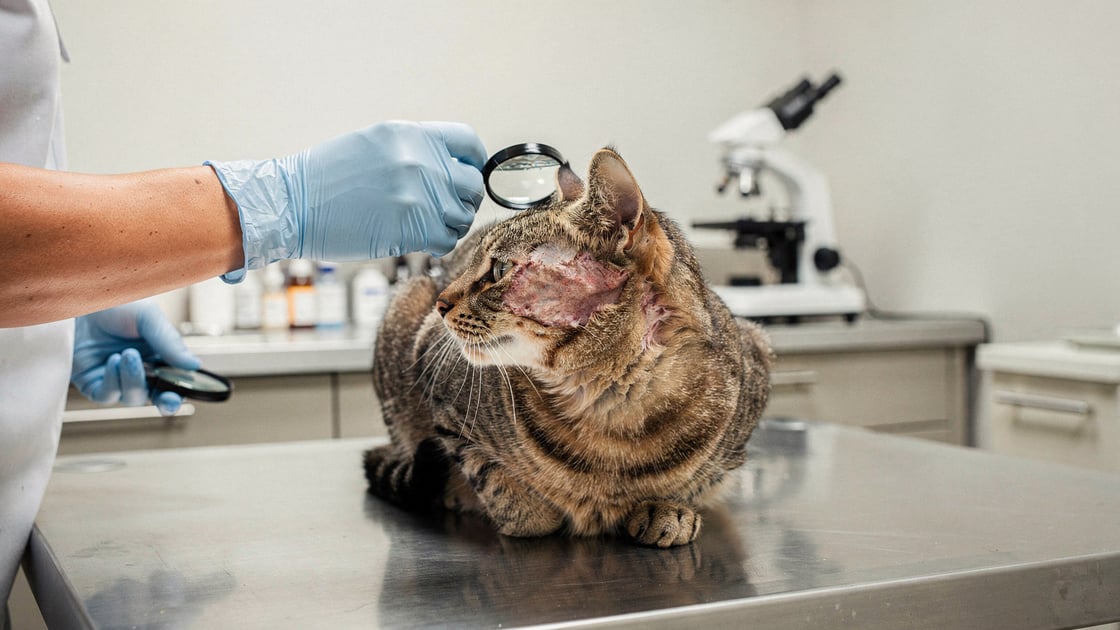
Veterinary dermatologist examining feline mange with magnifying loupe
Mange in cats — real vet costs and insurance guide.
01/04
Key Facts & Real Costs

The Parasite — Notoedres cati

Notoedres cati is a burrowing mite specific to cats, occasionally infesting dogs, rabbits, and humans. Direct contact transmits mites rapidly. The mite burrows into skin, laying eggs and triggering intense allergic inflammation. Related to but distinct from sarcoptic mange. Stray and multi-cat household cats are at highest risk. All household cats must be treated simultaneously.

Signs & Diagnosis

Starts at ear edges, spreads to face, neck, and legs. Signs: extreme itching, thick crusts, hair loss, self-inflicted wounds, and restlessness. Skin scraping diagnosis shows mites, eggs, and fecal pellets under microscope. Multiple scrapings improve detection. Mites visible on skin scrape confirmation.

Cost Breakdown — $150-$400

Exam: $60-$100. Skin scraping: $40-$80. Treatment (selamectin, ivermectin, or lime sulfur dips): $50-$150. Antibiotics for secondary infection: $60-$120. Follow-up scrape to confirm cure: $80-$150. Medication cost multiplies per additional cat treated. Mites survive poorly off the host — no professional environmental treatment needed.

Treatment

Selamectin (Revolution) topical is most convenient. Ivermectin (200 µg/kg weekly × 4 doses) is highly effective. Lime sulfur dips work but are unpleasant. Imidacloprid/moxidectin (Advocate) shows high efficacy. Most cats respond in 2-4 treatments over 4-8 weeks. Both highly effective in 4-8 weeks.

Total Cost — $200-$500

Exam + diagnosis + full treatment course. Add $50-$150 per additional cat in the household (all must be treated).

Prognosis — Excellent

Notoedric mange is highly curable with appropriate treatment. Recurrence occurs only if re-exposure happens (e.g., contact with untreated cats or strays).

Duration — 4-8 Weeks

Full treatment course takes 4-8 weeks with 2-4 treatments. Clinical improvement is often visible within 2 weeks. A final skin scraping confirms cure.

Human Risk

Notoedres cati can temporarily infest humans, causing a self-limiting rash. The mites cannot complete their life cycle on humans and resolve without treatment within a few weeks once the cat is treated.

02/04

The Real Cost

Vet exam + skin scraping + full treatment course for one cat.

Exam + skin scraping$100-$180 Treatment course$50-$150 Follow-up confirmation$80-$150
$300typical cost
03/04
Insurance Traps Mange is an infectious disease — coverage depends on policy type and waiting period.
Red flag · Coverage

Coverage Basics

Most comprehensive accident/illness policies cover mange as an infectious/parasitic disease. Exam, scraping, and medications typically reimburse. Wellness-only plans exclude parasitic infections — preventive treatments only.


Red flag · Pre-existing

Prior Skin Disease Trap

Pre-enrollment skin disease, scratching, or ear problems may trigger pre-existing classification even if mange wasn't diagnosed. Common trap — mange symptoms overlap with allergies and ear mites.

Red flag · Waiting period

14-Day Waiting Period

Mange claims within 14 days of enrollment are denied as pre-existing. Enroll cats while completely healthy and symptom-free.

Red flag · Multi-cat

Multi-Cat Household Cost

Each enrolled cat has its own deductible and copay. Unenrolled household cats are treated at full cost.

Pet Insurance Due Diligence Workbook
Happy readers

Happy readers

🇺🇸 US Pet Insurance Guide

Pet Insurance Worksheet

Not a book. Not a course. One printable worksheet that walks you through the exact questions and red flags — so you know what you're signing before you sign it. Takes 10 minutes. Saves you thousands.

Download the Worksheet

Instant PDF. Print it, fill it out, bring it to your insurer call.

04/04
Common Questions Real answers about feline mange, treatment costs, and insurance coverage.
0What type of mange do cats get?
Cats get notoedric mange from Notoedres cati (feline scabies). Related to but distinct from sarcoptic mange (Sarcoptes scabiei). Cats occasionally acquire sarcoptic mange from dogs, but notoedric is predominant.
1How do cats get mange?
Direct contact with infested cats spreads mange. Outdoor cats, strays, and multi-cat household cats are at highest risk. Newly adopted strays may carry mites asymptomatically. Kittens are particularly susceptible.
2What are the signs of mange in cats?
Signs start at ear edges and face: intense itching, thick crusts, hair loss, reddened skin, self-inflicted wounds, restlessness. Without treatment, spreads to paws and body. Secondary bacterial infections are common.
3How is mange diagnosed in cats?
Skin scraping confirms diagnosis under microscope — mites, eggs, and fecal pellets visible. Multiple scrapings from different sites improve detection. Classic presentations may be treated empirically without lab confirmation.
4How is mange treated in cats?
Selamectin (Revolution) topical, 2-3 monthly applications. Ivermectin (200 µg/kg weekly × 4 doses) also highly effective. Lime sulfur dips work but are unpleasant. Imidacloprid/moxidectin (Advocate) shows high efficacy. All household cats must be treated simultaneously.
5Can humans catch mange from cats?
Notoedres cati causes a temporary pruritic rash (arms, neck, torso). Mites cannot complete their life cycle on humans, so the rash self-resolves within weeks once the cat is treated.
6Does pet insurance cover mange treatment in cats?
Most comprehensive accident/illness policies cover mange as parasitic infection. Exam, scraping, and medications typically reimburse. Risk: pre-enrollment skin disease/scratching may trigger pre-existing denial. Wellness-only plans exclude parasitic infections.
7How long does mange treatment take in cats?
Significant improvement within 2 weeks. Full course 4-8 weeks with 2-4 treatments. Follow-up scraping confirms cure. Recurrence only with re-exposure — keep treated cats away from strays.

Related Conditions

Marcel Janik, founder of RealVetCost

I'm a dog owner who got burned

My mother-in-law took her German boxer to the veterinary emergency room — $1,200 in tests, no answers. A different vet solved it in minutes with $8 pills.

That moment stuck with me. When you're scared, you'll pay anything — and some vets price accordingly. I dug into vet costs and insurance. Confusing policies, buried exclusions, impossible to compare. So I built the resource I wish existed: real costs, real exclusions, plain language. Not here to sell you a policy. Here so you don't get blindsided.