Dog Bladder Infection: Symptoms, Antibiotics & Vet Costs
Frequent urination, blood in urine, accidents in the house — bladder infections are the most common urinary problem in dogs. Here's what to watch for, what antibiotics actually work, and what a typical case costs ($150–$600).
Most uncomplicated UTIs clear in 7–14 days on the right antibiotic. The trick is catching them early — and not over-treating with antibiotics that won't work.
What a Dog Bladder Infection Actually Is
A bladder infection — clinically called a urinary tract infection (UTI) — happens when bacteria colonize the normally sterile urinary tract. Approximately 14% of dogs will have at least one UTI in their lifetime, with female dogs more prone because their urethra is shorter and closer to the anus. The most common bacterial culprit is E. coli; it's the most frequently isolated uropathogen in dogs across published studies, with prevalence reported between 35% and 70%.
There's a meaningful distinction between sporadic bacterial cystitis (a healthy adult dog's first or rare infection) and recurrent UTI (defined by Merck Veterinary Manual as ≥3 episodes within 12 months, ≥2 within 6 months, or 1 episode within 3 months of a prior infection). The treatment paths and costs are different, and getting this distinction wrong is how dogs end up on the wrong antibiotic for the wrong duration.
Bladder infections are not the same as cystitis in the broad sense. Sterile cystitis (inflammation without bacteria) exists, especially in dogs with bladder stones or stress. Antibiotics won't fix sterile cystitis. This is why a urine culture matters — not just a dipstick — for any dog with recurrent symptoms.
The good news: a typical, sporadic dog UTI is one of the most successfully treated conditions in veterinary medicine. The harder news: when UTIs do recur, the underlying cause is rarely "the antibiotic didn't work." It's usually anatomy, an unaddressed comorbidity (diabetes, Cushing's), bladder stones, or — in male dogs — prostatic disease that needs its own workup.
Symptoms: What You'll Actually Notice at Home
Most owners notice changes in bathroom behavior first. Your dog asks to go out far more often than normal, sometimes every 30–60 minutes. They strain to urinate but produce only small amounts. They may have accidents in the house — even house-trained adult dogs. This is not a behavior problem; it's medical urgency.
Visible signs in the urine are the second tier of symptoms. Pink, red, or brown-tinted urine indicates blood (hematuria). Cloudy urine suggests white blood cells and bacterial debris. A strong, unpleasant smell — different from your dog's normal urine smell — also suggests infection. If your dog urinates indoors and you see these characteristics, take a photo before cleaning. Your vet can use it diagnostically.
Behavioral signs are subtler but real. Excessive licking of the genital area, restlessness, reluctance to settle, posturing to urinate without producing much, and — in advanced cases — fever, lethargy, or vomiting. Lethargy and vomiting in a dog with urinary signs is an emergency: it suggests the infection has reached the kidneys (pyelonephritis), which is a different and more serious problem.
Male dogs deserve special attention. Because their urethra is long and narrow, a true UTI in a male dog is uncommon — and when present, often signals a deeper problem (prostatic disease, bladder stones, or anatomical abnormality). "My male dog has a UTI" should always trigger a more thorough workup than "my female dog has a UTI."
How Vets Actually Diagnose It
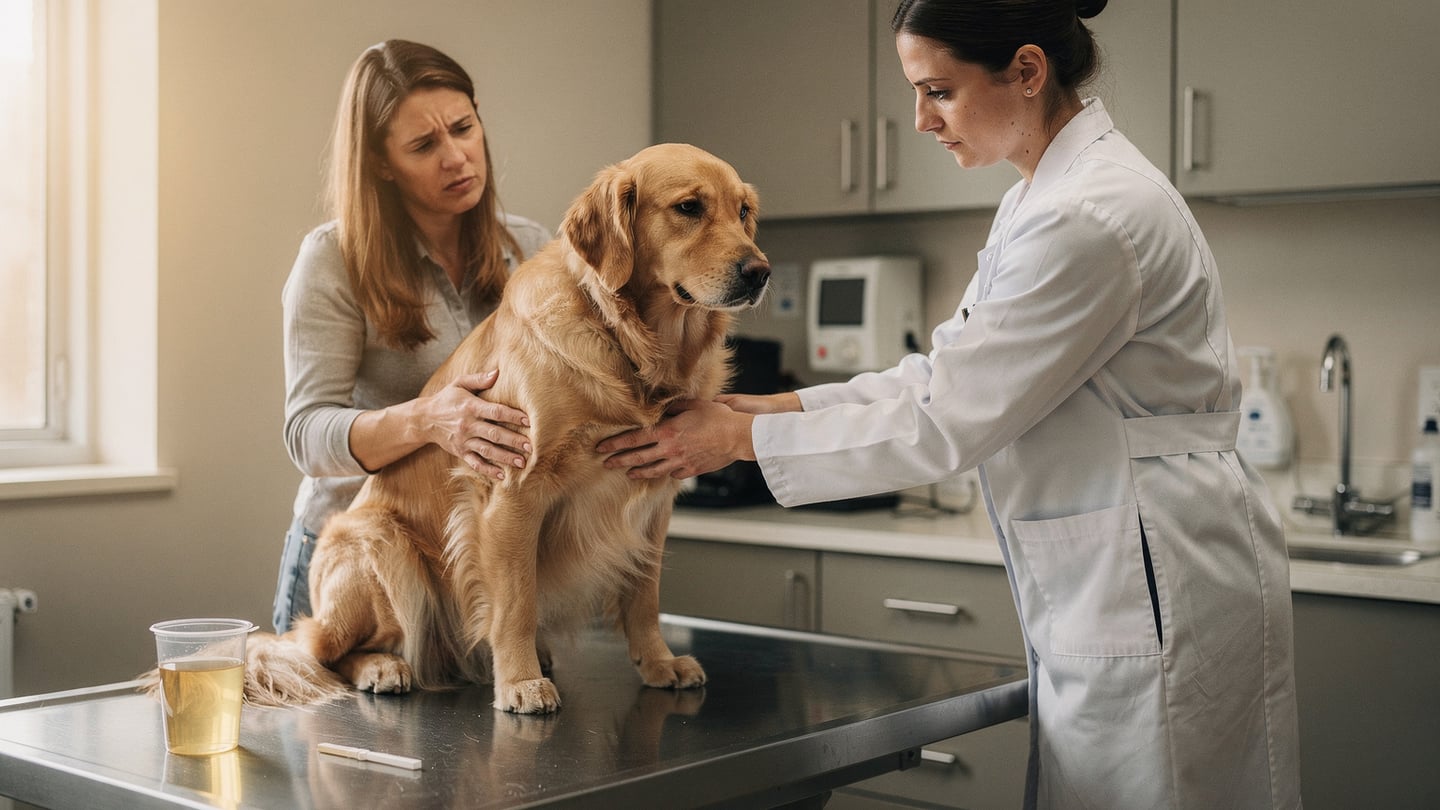
Diagnosis starts with a urinalysis ($30–$60). A fresh urine sample is examined chemically (dipstick for blood, protein, pH, glucose) and microscopically (white blood cells, red blood cells, bacteria, crystals). This is enough to confirm or rule out a UTI in most uncomplicated cases.
For confirmed or suspicious cases, vets often add a urine culture and sensitivity ($80–$180). The lab grows the bacteria, identifies the species, and tests which antibiotics actually kill it. This is the single most important step for recurrent UTIs because it prevents prescribing the wrong antibiotic — a common cause of "the infection keeps coming back."
For complicated cases — recurrent UTIs, male dogs, dogs with diabetes or Cushing's — imaging matters. Abdominal ultrasound ($300–$500) checks for bladder stones, tumors, or anatomical issues. X-rays ($150–$300) catch radiopaque stones. Bladder stones are a known contributor to recurrent UTI in some dogs (struvite stones are often secondary to UTI in the first place), so imaging is the right next step when standard treatment doesn't hold.
What you should expect to pay for diagnosis alone, before any treatment: $80–$240 for a basic case (exam + urinalysis), $200–$500 for a culture-confirmed case, and $400–$900 if imaging is needed for a recurrent or male dog UTI.
Antibiotics That Actually Work
For sporadic bacterial cystitis, the 2019 ISCAID (International Society for Companion Animal Infectious Diseases) guidelines recommend amoxicillin, amoxicillin-clavulanate, or trimethoprim-sulfonamide as first-line treatment for 3–5 days — significantly shorter than the 7–14 day courses common in older protocols. Shorter courses are now standard because they're equally effective and reduce antibiotic resistance.
Amoxicillin-clavulanate (Clavamox) is widely used in US veterinary practice for canine UTIs because it's effective against most E. coli strains and many vets are familiar with it. Cost for a typical course runs $25–$60 depending on dog size and whether the prescription is the original Clavamox or a generic.
Cephalexin and enrofloxacin (Baytril) are second-line options reserved for resistant infections or specific bacterial cultures. Enrofloxacin is overprescribed in some clinics — it's a fluoroquinolone, and the veterinary profession is trying to slow that prescribing pattern to preserve effectiveness for the cases that truly need it.
What does NOT work for UTIs: over-the-counter cranberry supplements (no clinical evidence in dogs), apple cider vinegar (potentially harmful, no evidence), "holistic" antibiotics, or watching and waiting. A real bacterial UTI does not self-resolve in dogs — it ascends to the kidneys. If your dog has UTI symptoms, see a vet within 24–48 hours.
What a Typical Case Actually Costs
Uncomplicated first-time UTI in a female dog: $150–$300 total. That's a vet visit ($60–$120), urinalysis ($30–$60), and a 5–7 day course of amoxicillin or Clavamox ($25–$60). No imaging, no culture, resolved in two weeks. This is roughly 60–70% of UTI cases.
Confirmed UTI requiring culture: $300–$600 total. Add a urine culture and sensitivity ($80–$180) plus possibly a follow-up urinalysis to confirm clearance ($30–$60). Common for any second UTI in the same dog or any UTI that doesn't respond to first-line antibiotics within 3–5 days.
Complicated or recurrent UTI: $500–$1,500. Includes imaging (ultrasound or X-rays), longer antibiotic courses (sometimes 4–6 weeks), repeat cultures, and possibly bladder stone removal surgery if stones are found. A dog with recurrent UTIs is no longer in the "simple antibiotic" budget.
What pet insurance covers (mostly): the diagnostic workup and antibiotics for the first UTI in a non-pre-existing condition policy. Recurrent UTIs become "pre-existing" fast — usually after the second occurrence — and many policies will exclude further UTI treatment. This is one of the more painful pre-existing pitfalls because UTIs are common, manageable, and exclusion makes the policy noticeably less useful for the dog you actually have.
Prevention and When to Worry
Frequent urination opportunities are the #1 prevention. Dogs that hold urine for 8+ hours have higher UTI rates. Walk schedules, dog walkers for working owners, or doggy doors for indoor-outdoor setups all reduce risk.
Hydration matters. A well-hydrated dog flushes the bladder more often and provides less time for bacteria to colonize. If your dog isn't a strong drinker, wet food or adding water to kibble helps.
Hygiene around the genital area — particularly for long-coated breeds and senior females — reduces ascending bacterial contamination. Trimming long hair around the vulva and gentle wiping after bathroom trips can prevent recurrent infections in older female dogs.
When to escalate beyond "this is probably a UTI": if your dog has fever (above 103°F), is vomiting, refusing to eat, or seems painful and lethargic, this is no longer outpatient care. Pyelonephritis (kidney infection from ascending UTI) and urinary obstruction (in male dogs) are emergencies that need same-day treatment, not a Monday appointment.
Common Questions
How can I tell if my dog has a bladder infection?
What antibiotic is best for a dog UTI?
How much does it cost to treat a dog bladder infection?
Will a dog UTI go away on its own?
Why does my dog keep getting UTIs?
Sources
- A note on this research. This is not medical advice. We're a designer and programmer writing research for the community. Treatment protocols, drug doses, and prices vary by vet, region, and individual case. For your dog's actual UTI, see a licensed veterinarian — not a website.
- ISCAID 2019 Antimicrobial Use Guidelines for the Treatment of Urinary Tract Infections in Dogs and Cats — the current evidence-based standard for UTI antibiotic selection and duration.
- Cornell University College of Veterinary Medicine — Bacterial Urinary Tract Infections in Dogs and Cats overview.
- Merck Veterinary Manual — Bacterial Cystitis in Small Animals (definitions, prevalence, recurrent UTI criteria).